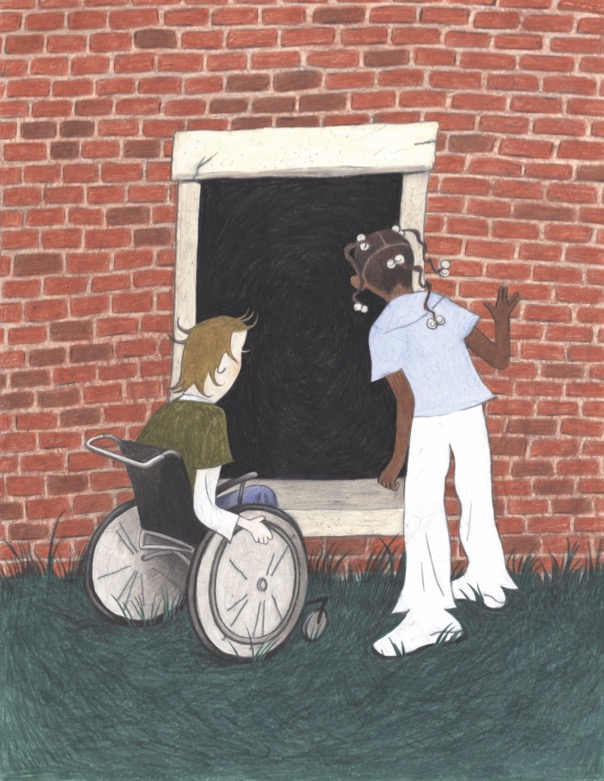

is a story for everyone.
Time Travel Wheels is a collaborative writing project between two survivors of Huronia Regional Centre, Marie Slark and Pat Seth, and critical disability scholar Kimberlee Collins. It was illustrated by Varvara Nedilska.
The book features Bernard and Jasmine, who discover the history of the Huronia Regional Centre through time travel, and in the process learn about the importance of friendship and interdependence.
“Time Travel Wheels beautifully captures the journey of Bernard and Jasmine, fast friends, who attend Orillia Middle School which has minimal access for students with disabilities. Through their time travelling adventures they learn about a history that is rarely discussed nor considered when thinking about how disabled people have ‘resisted’ or continue to ‘resist’ the collective harms that are part of the legacy of ableism, eugenics and other systems of discrimination.“
— Fran Odette, Faculty at George Brown College and co-author of the Ultimate Guide to Sex and Disability: For All of Us Who Live with Disabilities, Chronic Pain, and Illness
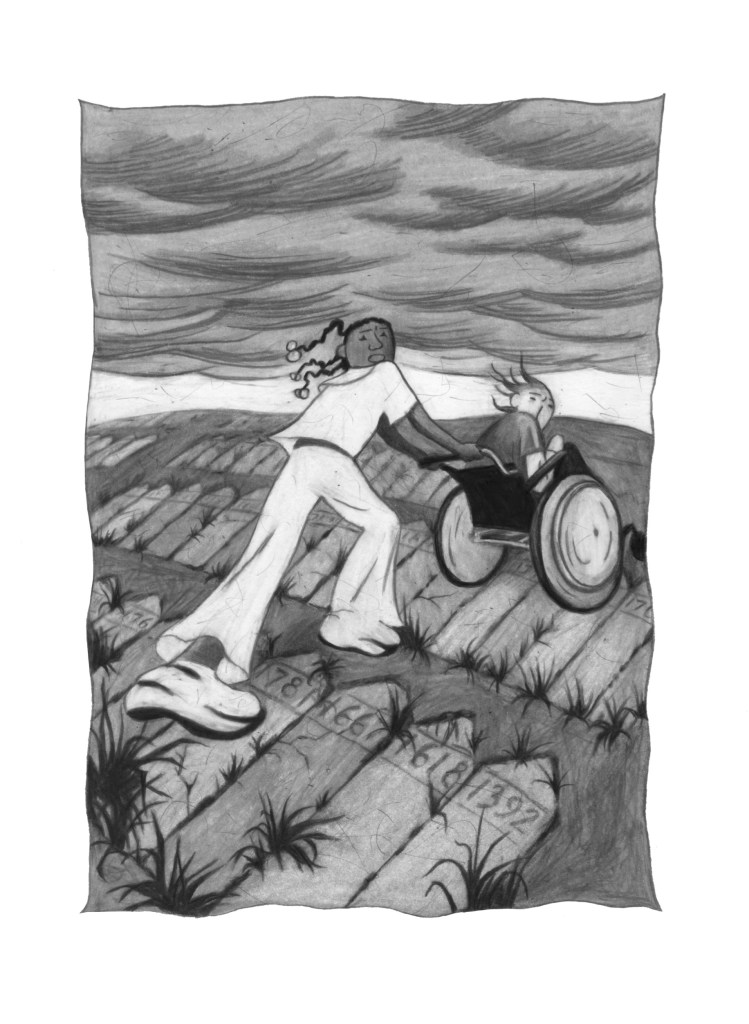
All illustrations by Varvara Nedilska
“All people need to know this history so that it will not happen again. If you let things fester and don’t talk about tough issues, things won’t change.
Because of [survivor] storytellers, I can live with who I want, where I want and I get to do lots of projects I want, like writing plays and musicals. People think that discrimination is over but it’s not.”
— Andreas Prince, Actor and Playwright with an intellectual disability
“Readers will find themselves endeared to Bernard and Jasmine whose young lives unfold under institutionalization’s shadow, yet together with disabled survivors and elders they embody the crip community wisdom to create a more just future.
Time Travel Wheels imaginatively and compassionately challenges readers to consider how we will honour the past and, at the same time, mobilize an anti-eugenic future.”
— Chelsea Temple Jones, Assistant Professor in the Department of Child and Youth Studies, Brock University
 Time Travel Wheels